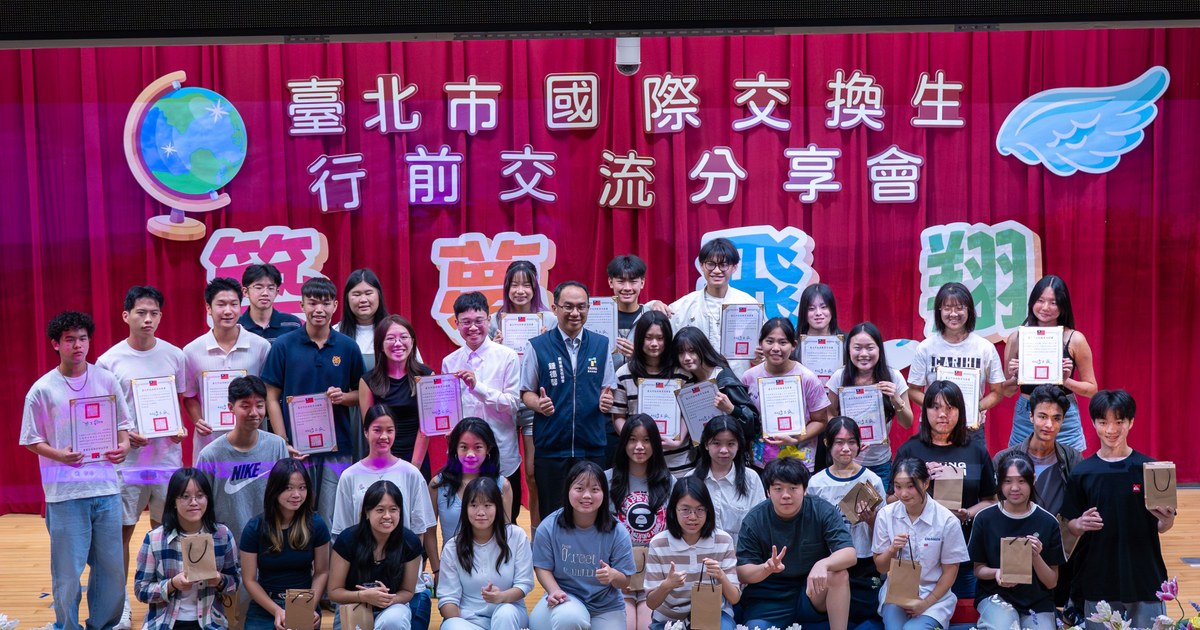
The Taipei Municipal Education Department has a joint international student exchange programme for the 115th academic year. 25 students Through selection, one-year exchange studies will be undertaken in the United States and Canada. The Department of Education also arranges for students who have returned home in the previous school year to share their experience of living abroad, cultural adaptation, residential family and extracurricular activities, as a pre-departure preparation for new students.
The programme targets students from the ninth grade to the second grade of high school in the country. According to the Department of Education, the purpose of international exchanges is not only to improve language skills, but also to foster intercultural understanding, independent thinking and adaptability to strange environments through physical access to local schools and family life.
The biggest difference between one year of exchange and short-term study.
As can be seen from the experience of returning students published by the Education Department, the core of the annual exchange is not “visitation”, but long-term access to the local education system. Students need to deal with the norms of life in the formal curriculum, in associations or school teams, in boarding families, in interpersonal interaction and in different cultural contexts.
In cases shared by EDB, students are involved in a number of teams and associations in Canada, as well as in local honorary bands and state-wide selections for students travelling to the United States. The value of such experience is often derived from long periods of accumulation rather than from one-off overseas activities.
Local governments are beginning to institutionalize international education
The city of Taipei continues to send students abroad in exchange for municipal projects, and international education is no longer organized by individual schools alone. A complete system has evolved from student selection, pre-departure instructions, support during the exchange period to the memory of the return experience.
In the case of parents, in addition to the costs and the country, the assessment of the high school exchange programme should be informed about credit recognition, post-repatriation connection, residential family arrangements, student support mechanisms, and whether there is real access to the regular curriculum of local schools during the exchange period.
This is also the direction in which Taiwan's international education deserves sustained follow-up: overseas learning is gradually evolving from an “active exchange” to an educational system with selection, learning objectives and a link to return home.
