
"Readering the System, Choosing the World"
Department of Chemistry vs Chemical Department: one word missing, much worse route to life
A lot of high school students fill out their volunteers and see that there's a big difference between the orientation of these two faculties. Chemical systems tend to study substances, molecules, reactions and analyses. The chemical system tends to magnify the reaction into semiconductors, energy, materials, pharmacies and industrial systems. One is more like scientific research. One's more like engineering applications.
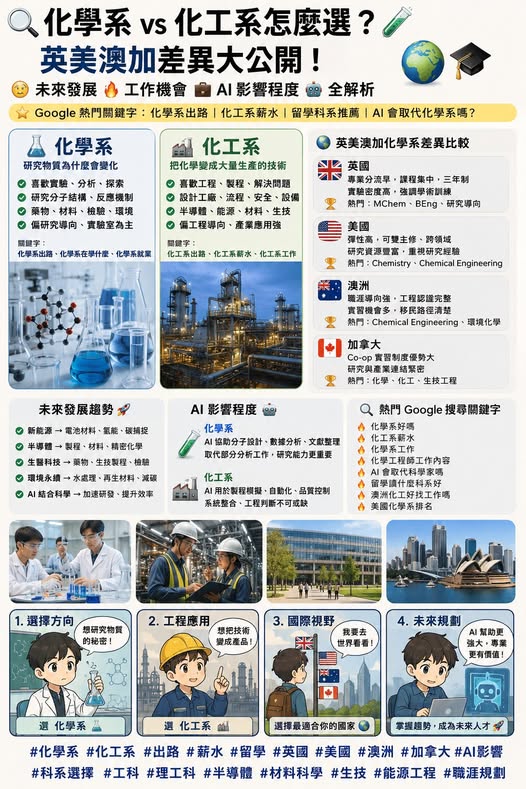
[vs] Many high school students fill out their volunteers and see that there's a big difference between the orientation of the two faculties. Chemical systems tend to study substances, molecules, reactions and analyses. The chemical system tends to magnify the reaction into semiconductors, energy, materials, pharmacies and industrial systems. One is more like scientific research. One's more like engineering applications. If a new bottle of material is taken from the laboratory to the industrial side, the chemistry department is responsible for identifying possibilities, and the chemical department is responsible for making it a mass product. The core of the chemistry system is the substance itself. Students will be exposed to organic chemistry, inorganic chemistry, analysis of chemical, biochemical materials, chemical analysis, experimental design, the most commonly trained in chemistry are observation, reasoning, analysis and validation.
And you're thinking about how this molecule reacts, why this material is of a special nature, and whether this drug molecule is capable of producing the effects of this food, medicine, water quality, or environmental samples, so that, after graduation from the chemistry department, the common orientation is to include drug research and development materials, semiconductor materials, food testing, environmental testing, cosmetics development, forensic forensic forensics, laboratory analysis, research assistants, teaching and research institutes, if students want to move forward with research and development, new drugs, new materials, AI chemistry, computing chemistry. The full name of the chemical department is chemical engineering. It brings together chemical, physical, mathematical, engineering, energy and industrial processes.
Students will be exposed to engineering mathematics, thermodynamics, fluids, mass transfer, heat-transaction engineering, program control, plant safety, energy engineering, material engineering, chemical engineering, concern about how a reaction can produce in large quantities, how a production line can be designed, how a process can be designed to save energy, how a plant can balance safety, efficiency and cost, how a material enters a semiconductor, battery, pharmaceutical plant, biotechnologie or energy industry, so that, after graduation from the chemical industry, the common direction consists of semi-directorial system engineer, programme integration engineer, material engineer, petrochemical engineer, energy engineer, battery plant, biotechnologies, food engineering, quality engineering, safety in Taiwan, the chemical background and semiconductor, materials, energy, biotechnologies, petrochemical industry are connected, and the occupational route is relatively clear.
Great Britain, the United States, Australia, Canada. Students who read Chemistry quickly enter core training in organic, inorganic, physical, analytical, materials, etc. Many universities offer a four-year MChem for students who wish to go to research, doctoral, pharmaceutical or material chemistry. Chemical Engineering is a common BEng three years and Meng four years. If the future is to be followed by engineers in the UK, course certification and professional qualifications are important.
For students, it's clear that they want to move quickly into the profession, prefer the short-term system, and want to connect with a master's degree or a doctorate in England, and the four-year elasticity of the United States, where students can combine information science, biology, pre-medicine, materials, environment, computer science. The chemistry system can go along with pharmaceuticals, biochemistry, computational chemicals, science, environmental chemistry, AI, chemistry, chemistry, science, and so on with bio-engineering, energy, semiconductors, nanotechnology, materials science. It's good for a student, and it's good for a student, and it's good for a student, and it's good for two majors or a side study, for a university, for a future thinking institute, for a medical college, for a biotechnologies or for a technology industry. The chemistry system has access to food, medicine, the environment, materials, education and research.
Chemical industries are often linked to energy, mining, the environment, production processes, materials, and biotech industries. The Australian engineering career is closely related to Engineering Australia certification, and students who want to follow the engineer route are selected to be aware of course recognition. Appropriate for students: Interest in energy, environment, mining, biotechnologies, engineering; Future consideration of Australian employment or skilled immigrants. Research-based universities in Canada are strong, as is the Co-op system of paid internships. The common direction of the chemistry system consists of pharmaceuticals, analytical chemicals, environmental chemistry, biochemistry, energy, environmental engineering, bioprospecting, food, materials, petrochemicals, semiconductors and pharmaceuticals.
If a student wants to become a professional engineer in Canada in the future, the engineering course certification and the P.Eng. route are evaluated ahead of schedule. How the chemistry and chemistry departments will change in the age of AI, and how it will affect chemicals and chemicals greatly. But does that mean the department is gone? The answer is no. AI will quickly enter into molecular predictions for new medicines Documentation Analysis of experimental data Searching material Response path proposal Automation of plant Forecasting maintenance Quality control Chemical students will be experimenting with data analysis, AI tools, Python, machine learning, chemical databases.
In the future, students in the chemical industry have to understand the process, as well as simulation software, automation, data monitoring, energy management and intelligent manufacturing. AI will eliminate duplication of operations, but will leave out those who ask questions, validate them and integrate cross-cutting competencies. The future of work, the chemistry and the chemical industries are highly relevant to the future industry. The best combination in the future would be chemical x AI chemical x chemical x material chemical x environmental persistence chemical x semiconductor chemical x energy x chemical x data analysis chemical x intelligence manufacturing chemical x ESG, if you want to study in such faculties abroad, you can think about the concentration of British expertise for targeted students. The United States is the most resilient and suitable for cross-cutting and exploratory students.
Australia has a strong career orientation and a clear link between engineering and industry. Research and Co-op internships in Canada have a clear advantage and are suitable for students wishing to build on their experience in North America. Under the wave of AI, the division of science and technology is accelerating. Chemicals who use AI will be more competitive than traditional chemists. Workers who combine data with programming can be more staged than simply project implementers. There are two ways of thinking behind the one word difference between chemistry and chemistry. One from the molecules. One from industry. Selecting the right direction would make the four-year university the starting point for the next decade. Click on the bottom label to see more of Peter's depth analysis
