"Readering the System, Choosing the World"
Kids are facing a new world, and parents can't educate with old answers.
A lot of parents don't think kids work hard. Sometimes, however, the child is not trying, but working in a way that the parents do not understand. They might learn to clip, design, write, run communities, do projects, compete, study AI tools, or even try to turn a little idea into a business plan.
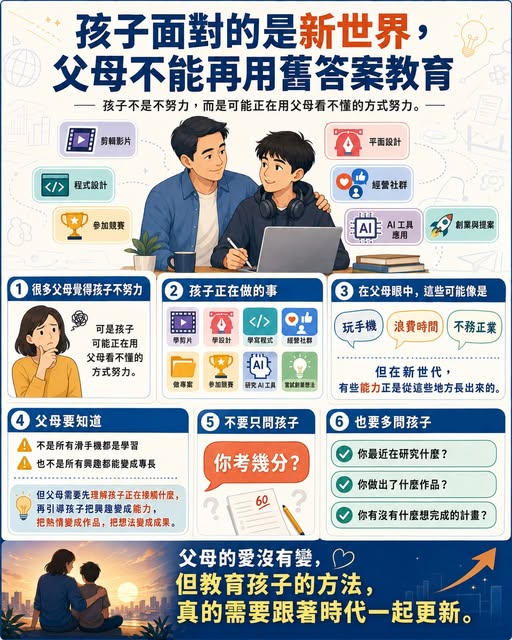
A lot of parents don't think kids work hard. Sometimes, however, the child is not trying, but working in a way that the parents do not understand. They might learn to clip, design, write, run communities, do projects, compete, study AI tools, or even try to turn a little idea into a business plan. In the eyes of their parents, these may look like "playing a mobile phone", "waste of time" and "discretionary business". However, in this new generation, many of the capacities that will be needed in the future have slowly grown from these places. Of course, not all slipphones are learning, nor can any interest become a specialty.
But what parents really need to do is not to deny it at first, but to understand what the child is dealing with, then to guide the child into the ability to turn passion into work and ideas into results. In the past, we used to ask the kids, "How do you score?" But now we should ask more: "What have you been working on?" "What did you do? "Do you have any plans to complete? The children face a whole new world. The love of parents has not changed, but the way children are educated really needs to be updated with the times. Children need parents who are willing to renew their thinking. Parents willing to understand the new world. In the past few years, there has been a shift from "control of the child" to "upgrading with the child" parents.
The final words create an entry, transition, exit and comparison strategy.
International advancement should not simply follow up on an admission notice, but rather establish a path that students can understand, that families can afford and that can still be adjusted when the environment changes.
When institutions, policies and markets are changing, the most valuable ability is not to predict the only answer, but to continuously compare options, collate information and put students ' interests, abilities and long-term development back at the centre of decision-making.
May this book become the starting point for dialogue among families: understanding the world before choosing their own direction.
Peter International Educational Lecture
