"Readering the System, Choosing the World"
The entire British student visa application.
It's time to get ready for student visas again. First known: The British student visa is called Studenvisa, a well-known British Tier 4 Studen Visa, which has now been changed to Studenvisa.
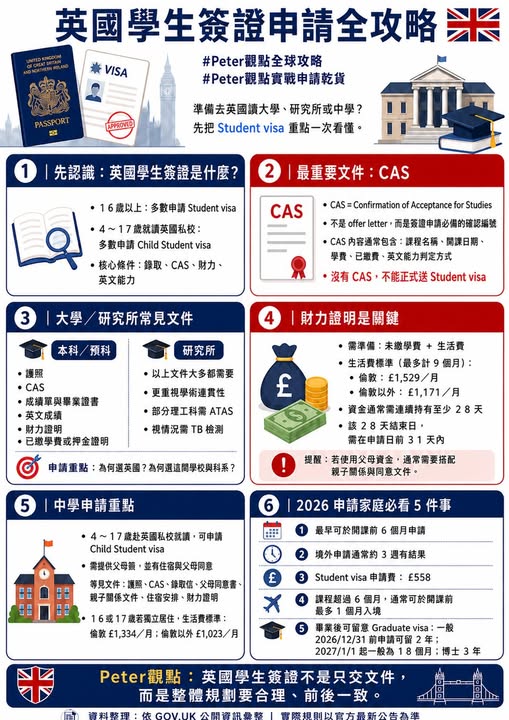
It's the season of preparing for student visas. First known: The British student visa is called Studenvisa, a well-known British Tier 4 Studen Visa, which has now been changed to Studenvisa. Generally speaking, students over 16 years of age who wish to attend universities, research institutes, preparatory studies, Further Education courses or qualified English courses in the United Kingdom usually apply for Student visa. If students are younger, especially between the ages of 4 and 17, to attend private British schools, ChildStudent visa may be used.
The basic logic of a British student visa is that there are three key questions: whether or not a student is admitted to a British qualified school; whether or not a CAS student can justify tuition, maintenance and study purposes; so, instead of getting an offer, a British visa passes automatically, it is necessary for the student to issue a CAS before the student can apply for a visa. The most important document for British student visas: CAS CAS, full name of Association of Students for Studies, can be read as “Access confirmation letter” or “Accreditation of student visa guarantees”. CAS is the number of a visa issued to students by British schools through Home Office.
Students are required to enter CAS reference number when filling out their visa application form. The common process is as follows:1 Students who have obtained admission to a British school2 Students who have fulfilled the requirements of their school, such as the payment of a deposit, the provision of a passport, financial means or educational documents.3 The CAS 4 students who have been approved by the school will not officially be sent out of the CAS until they have received the CAS, which will normally include: Basic Information for Students; School and Course Name; The amount of tuition fees paid at the beginning and end of the course; The English method of determination; School Guarantee Information; The CAS is at the heart of the entire application.
The visa review may be affected if the CAS information is not consistent with the student ' s passport, education, curriculum, payment record.
University applications focus: CAS, financial certification, English proficiency, learning connection Applications for British universities Common documents include: 1 valid passport 2 CAS 3 Official admission documents for British universities 4 Financial certificates, e.g. high school report cards, diplomas, pre-schools, or OSSD results 5 Certificates of English proficiency, e.g. IELTS, PTE, TOEFL, or school-accredited English test 6 Financial certificates 7
Focus of the Institute ' s application: Academic coherence and ATAS need to pay particular attention to applying to the British Institute, where visa documents place more emphasis on the interface between academic background and curriculum than universities. Common documents include: 1 valid passport 2 CAS 3 university report card 4 or certificate of proficiency 5 English certificate 6 financial certificate 7 CV curriculum vitae if required by the school or faculty 8 research programme 9 scholarship or funding documents for research masters or doctorates 9 ATAS if the faculty involves a particular field of science, engineering, technology or sensitive research AATAS is an easily ignored document for many students.
Students may need to obtain ATAS before applying for a visa if they apply for studies related to some of the sciences, engineering, technology, shipping, materials, AI, physics, chemistry, bio-engineering, etc. In particular, students at the Institute do not recommend to wait for CAS to come out and start checking ATAS. Because if ATAS takes longer clearance time, it is likely that the successor visa and ticket arrangements will be reduced. The focus of secondary school applications is: Child Student Visita, accommodation, guardianship and parental consent. The British secondary school study study is not the same logic as university applications. For example, in addition to admission to schools, visa reviews also focus on student care arrangements in the UK.
If the student is between the ages of 4 and 17 years and attends a private British school, Child Student visa is usually considered. Common documents for secondary school students include: 1 valid passport 2 CAS 3 British private school admission documents 4 parental or legal guardian consent 5 parental or paternity documentation 6 Accommodation arrangements such as dormitories, residential homes, family residence 7 parental financial proof 9 parental certificate TB tuberculosis testing, which is important if applied to students under 18 years of age. The secondary school visa does not depend solely on merit, but on whether the student is cared for upon arrival in the United Kingdom, where he or she lives, whether the school is fully organized and whether the parents have formally agreed to it.
For younger students, accommodation and custody arrangements are sometimes more critical than report cards. The British study study abroad has not started from the day of boarding, but from the day when you started to prepare the visa documents, it has reached the formal stage of preparation.
