
"Readering the System, Choosing the World"
Apprenticeship at the University of England
British higher education actually has another distinctive route: Apprenticeship. It's a simple concept: students work in enterprises, receive professional training from schools or training institutions and finally acquire formal qualifications.
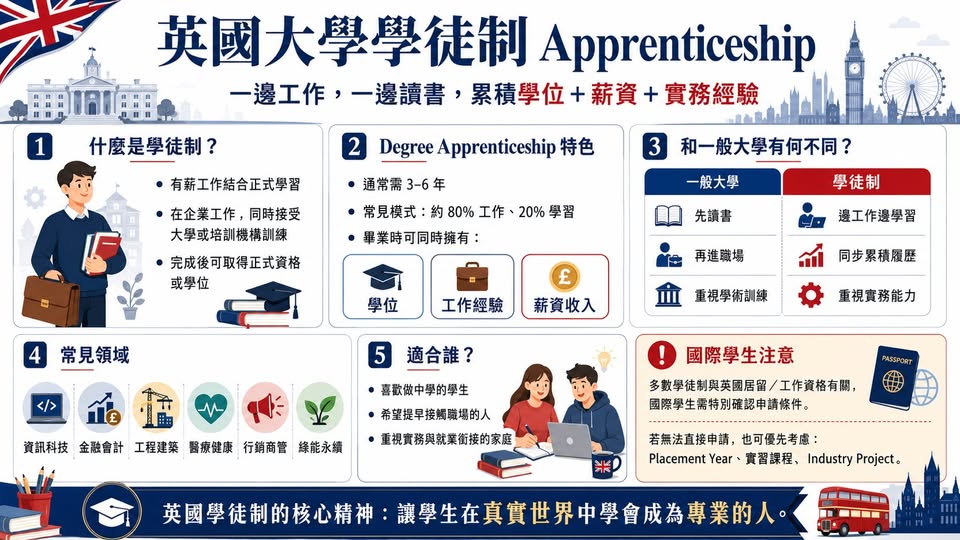
British higher education actually has another special route: Apprenticeship. It's a simple concept: students work in enterprises, receive professional training from schools or training institutions and finally acquire formal qualifications. The official British definition of apprentischeship is "payable work in combination with study " , where students gain practical experience in their work while completing formal qualification training. One of the most attractive is the Degree Apprenticeship. Such courses allow students to pursue undergraduate or master ' s degrees during their work.
UCAS states that it usually takes between three and six years to complete the project, with students working mostly in the enterprise and part of their time attending university or receiving training; The usual arrangement is about 80% work, 20% study. What's the difference between that and a normal college? The general university route is first reading and then entering the workplace. The British apprenticeship system is: reading and working in tandem. Once a student enters the enterprise, he/she will have a real position, job responsibilities, pay and job training. The end of the school is responsible for the academic curriculum, expertise, evaluation and qualification structure.
In other words, students may have three things on their hands at the same time: degree or professional qualification, work experience, salary income, which is why Britain has been paying increasing attention to apprenticeship in recent years. The British Government ' s Apprenticeship Search Platform also indicates that during apprenticeships, students work, receive salaries and qualify for training. Which areas are common? British apprentisship is not restricted to traditional technical fields.
A number of degree applications are now in high-paying and professional industries, such as accounting for information technology and software engineering, finance, auditing engineering, construction, manufacturing, marketing in areas related to health and nursing, business management, human resources greening, sustainability, advanced manufacturing UCAS, and the auditing, finance-related applications of large enterprises such as KPMG, some of which are at the Higher Apprenticeship or Degre Apprenticeship levels. There are many professional abilities, and it is very difficult to rely on textbooks alone.
For example, medicine, engineering, design, finance, education, marketing, and consultancy work have a lot of content "to follow, to see how the older generation judges, and to make amends in the real situation." That's the core spirit of the Apprenticeship. It does not place students in the workplace to work, but rather allows them to be trained, evaluated, asked and gradually brought into a professional field. The thinking behind this system is very interesting: English education values “knowledge” and “how to use it on real issues”. However, international students need to pay particular attention to the reference value of apprentisship for Taiwan students, but special attention needs to be paid to identity and visa conditions in applications.
Officially, the UK states that applying for application is usually required to be 16 years of age, resident in England and not a full-time student at the beginning of the application. Similar conditions are listed in UCAS: 16 years of age, resident in UK, part-time education. In addition, the British apprentischeship involves government-funded employment with employers, so many job openings require applicants to meet the conditions of residence and right to work.
UK 2025-2026 application funding rules state that training institutions can only apply for application funding for those eligible for residence. So, for international students who usually travel on student visas to British universities, degree accessship is not necessarily the easiest direct route to access. However, it is still very interesting to know, as it represents the direction of British cooperation in higher education and industry. What is the inspiration for Taiwan students? The British apprentischeship is a very important reminder: it's not just about ranking, it's about the connection between the school and the industry.
For example, are there courses on business cooperation? Do you have a year of placement year? Is there an industrial project? Can the collection of works, internships, research, competitions be integrated into the curriculum vitae? Is there a career centre to help students connect to the job market? For international students, a truly operational route is usually not necessarily an applicationship itself, but a choice of university courses that value practice, internships, industrial cooperation and career orientation.
For example, in the United Kingdom, it is common to say that the Employment Year Sandwich Court Internship Industrial Project Project Graduate Road Employment Connecting Plan is very much in line with the spirit behind Apprenticeship: to allow students to begin understanding the workplace, to contact industry and to build up their résumés while they are in college. If a student likes to go to high school, it's a good idea for the UK. Higher education in the UK is not limited to traditional academic paths, but also very mature career-oriented designs.
From the degree applicationship to the placement year, it reflects the same direction: students need not only to take exams, but also to translate knowledge into abilities. It's not just about getting a diploma, it's about knowing what kind of industrial role you're going to have in the future.
