
"Readering the System, Choosing the World"
Why is British university fees getting more expensive?
From the point of view of university spending, international student and higher education financial pressure, it appears to be a unilateral increase in university costs. But the financial structure of tertiary education in the United Kingdom is more complex. British universities are facing three pressures: long-term low school fees for local students, rising costs of teaching and research, and increased volatility in international student enrolment.
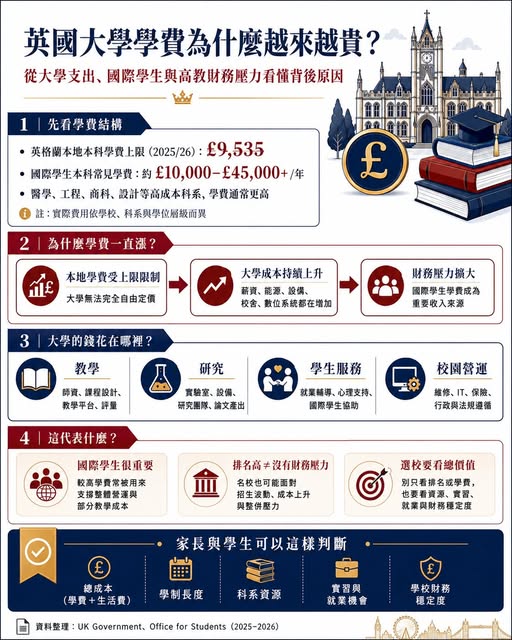
Why is British university fees getting more expensive? On the face of it, it's like a university unilaterally increasing costs, starting with university spending, international student and college financial pressure. But the financial structure of tertiary education in the United Kingdom is more complex. British universities are facing three pressures: long-term low school fees for local students, rising costs of teaching and research, and increased volatility in international student enrolment. These three things come together, which is today a phenomenon in which British universities are "bringing money while raising their tuition fees." One, local English students' tuition fees have been restricted for a long time, and not all British universities pay the same tuition fees. In England, for example, tuition fees for local university students have long been subject to government ceilings.
The British Government has announced that the maximum local full-time undergraduate fee for the school year 2025/26 has been adjusted to £9,535; After 2026/27, however, the school fees ceiling will be further adjusted to the inflation regime, but it is still subject to governmental and regulatory restrictions. This means that the tuition income of English local students is not fully priced by universities. However, university expenditure has not been frozen. The salaries of teaching staff, campus maintenance, laboratory equipment, energy costs, digital systems, student support services have increased with inflation and regulatory requirements. When local tuition revenues do not catch up with expenditure, schools naturally need to be replenished from elsewhere. 2. International student fees are an important source of university finance. International student fees are generally higher than those of local British students, and most faculties are subject to university policy.
International tuition fees for students in general undergraduate courses are commonly jumped from about £10,000 to close to £45,000 for some courses; Medical courses may even be higher. International student tuition, which is a "cross-subsidized" function, has been repeatedly mentioned in discussions between the British Congress and higher education finance, namely the higher tuition income of international students, which partly supports the cost of teaching, research activities and campus operations for local students. In other words, the tuition fees paid by international students are not just a classroom, a teacher and a diploma; It is also involved in supporting the operation of the entire university system. This is important for parents in Taiwan. The selection of British universities depends, in addition to ranking, on whether the university is financially healthy, whether the international student ratio is over-centralized, and whether the Department of Hotgate is still adequately staffed and resourced.
3. University expenditure has increased from three main blocks of teaching, research and student services.
1. Teaching costs
The British leading schools focus on research ranking, dissertation, laboratory equipment, doctoral development and research teams. Many research funds are not fully funded by Governments or enterprises, and universities often need to raise part of their own resources. 3. The cost of student services includes employment counselling, mental health support, international student services, visa support, accommodation coordination, learning support, physical and mental disability resources. School and administrative costs include school building maintenance, energy, insurance, IT systems, financial security, compliance, data management and international recruitment teams.
According to the Library of the United Kingdom Congress, public funds for higher education in England include tuition loans, Office for Students teaching grants and Research England research funds; Of these, OfS allocated approximately £1.4 billion teaching grants for the year 2024/25, mainly to support courses whose cost is above the affordable range of tuition fees. This explains one thing: high-cost courses in engineering, medicine, experimental science, art design, etc., often cannot be fully supported by general tuition fees alone. 4. Why do universities still have high rankings and financial constraints? University finance depends not only on income but also on the cost structure and risk of enrolment.
In its 2025 Financial Sustainability Report, Office for Students reminded that while the institutions of higher education in England are still functioning as a whole, the fluctuations in enrolment, costs, cash flows and the international student market have put many schools under pressure. In 2026, there were more representative phenomena. For example, King's College London announced a merger plan, which is widely read in the context of the financial pressures of British high-schools and the re-engineering of research competitiveness. In addition, large-scale staffing adjustments and lay-offs have recently been reported, one reason being the decline in the number of international students and the increase in financial pressure.
This reminds us that the brand of the University of England is not always consistent with financial health. High-ranking schools may also be under pressure as a result of school expansion, research spending, fewer international students and changes in government policy. 5. Government policy has also made it more difficult for universities to plan for Universities UK analysis, indicating that changes in government policy may result in a reduction in funding of about £3.7 billion between 2024/25 and 2029/30 for institutions of higher education in England. On the other hand, the British Government has also proposed the concept of an international student tuition income tax, Levy.
The impact analysis mentioned that OfS estimated an increase in the cost of undergraduate science in the United Kingdom in 2026/27, which could generate about £440 million in additional income for the higher education sector; However, if international students were increased simultaneously, some of the income effects could be offset. For universities, this is a dilemma: tuition fees need to be increased to cover costs; However, the higher the tuition fees, the more international students compare with their parents the other options available in Canada, Australia, the United States, Europe and Asia. 6. Will British tuition continue to rise for international students? Look in the big direction, will. The reason for this is simple: local British students are limited in their tuition fees, while university costs are still increasing; As a result, international student fees will continue to be an important source of income for university adjustment. But there is also a ceiling on the increase in school fees.
If there is too much growth in British universities, students may be transferred to other countries. In particular, in Canada, Australia, the English-language course in Europe, and the International Academy in Asia are competing for the same group of students. British universities must strike a balance between maintaining income and keeping it attractive. As a result, three trends may be observed in the coming years: first, the hot and high-cost systems continue to increase prices. Such as business, engineering, medical-related, AI, information science, design, architecture, etc. Second, some universities offer more scholarships and early payment discount. The tuition fees appear to be high, but when actually admitted, the student burden may be adjusted through scholarships. Thirdly, universities attach greater importance to the international recruitment structure. In the past, some schools were highly dependent on students from specific countries and in the future would be more decentralized to reduce the risk of enrolment.
Seven, parents really want to see more than a year's tuition, and it's easy to miscalculate the cost of studying in England. A more complete assessment should include: school fees, which vary widely from one department to another and are usually relatively high in business, engineering, medicine, art design. The gap between London and non-London cities is clear. School fees and accommodation costs are usually higher in London. The length of the undergraduate program in England is three years, and the master's degree is one year. Even with high single-year tuition fees, the overall time cost may be lower than in four-year countries. If the courses are given in the form of a certificate year, an industry project, or a programme, the tuition fee may be higher, but the value of the career may be higher.
School finances and resources are allocated to observe whether the school is investing continuously in student services, employment centres, laboratory equipment and international student support. Peter's point of view: the problem of tuition fees at British universities is essentially the financial weighting of higher education. The rise in university fees at British universities is part of the global financial pressure on higher education. (a) University spending is significant if it is to maintain its research ranking, the quality of teaching and international competitiveness; However, local tuition fees are limited by the Government and public subsidies are limited, with international students naturally becoming an important source of income. The British study abroad is still valuable, but the selection logic is much more subtle than in the past. In the era of high school fees, it is really important to spend the money on options that have long-term returns.
United States: enrolment trends and application strategies
The system is the map, the choice is the direction.
