
"Readering the System, Choosing the World"
Fashion Department: Design, Digital Tool Integration with Sustainable Industries
Referring to the fashion industry, it is an amazing costume design, stretcher and fine brand. From AI trend analysis, digital printing, 3D sampling, continuous fabric, marketing of community images, to branding content, fashion is moving rapidly towards technology.
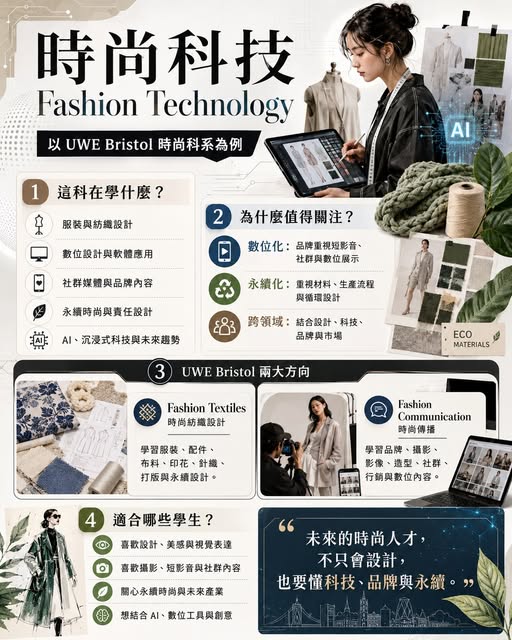
Referring to the fashion industry, it is an amazing costume design, stretcher and fine brand. From AI trend analysis, digital printing, 3D sampling, continuous fabric, marketing of community images, to branding content, fashion is moving rapidly towards technology. As a result, "Fashion Technology" in fashion technology has become a very interesting direction in international design education in recent years. Fashion technology is a cross-cutting discipline that combines design, beauty, technology and industrial applications.
Students learn not just about costume design, but also about contact: clothing and textile design digital design and software applications social media and brand content continue with responsibility design AI, immersion technology and future consumption trends, that is, students learn not only how to design a dress, but also how to make it, how to see it, how to connect to brands and markets. First, digital. The brand increasingly relies on short audio, community content, online activities and digital displays. Second, perpetuity. Future designers will have to think about sources of material, production processes, waste reduction and recycling design. Third, cross-cutting. Fashionians know more than beauty, but also brands, images, consumer psychology and digital tools.
As a result, fashion technology develops new creative talent that can be integrated between "design x technology x brand x sustainability". Fashion-related departments, such as UWE Bristol, are well suited as examples of modern science and technology education. BA(Hons) Fashion Textiles Fashion Textile Design This course focuses on the creation of clothing, accessories, textiles and indoor textile series, as well as on continuous and digital design.
Students learn about clothing structures, fabric printing, knitting, embroidery, layout and future fashion concepts, and can also develop personal features in the direction of Fashion Design, Textile Designs, etc. It suits students who like to create hands-on work, fabric experiments, clothing structures and permanent design. If students are interested in branding, photography, short audio, community, modeling, marketing, and content planning, Fashion Communications will be the right direction.
This course trains students to "speak fashion stories" and to create influential brands for the dissemination of their work through photography, video, art guidance, graphic design, community platforms and digital content. UWE's Fashion Community also incorporates AI, immersion technology and digital platform applications, bringing students closer to the needs of contemporary fashion industries. The features of the UWE Fashion Department, which values the collection of works and the ability to produce, combines industry projects and professional practices, is located in the Bristol Creative City Environment, provides digital design, Adobe, VR, iPad, etc., and connects future fashion design, branding, media, marketing, modeling, photography, content production and sustainability.
Design, beauty and visual expression, photography, short video and community content, costumes, fabrics and handmade creations, care about the future of the future industry, and want to combine design with AI, digital tools, video technology, and hope for future international fashion, brand or creative industries. The fashion department of UWE Bristol demonstrates this international design education orientation: putting creativity, work, technology and career abilities in the same learning path. For students who want to move to international fashion, design, branding and creative industries, fashion technology is an interesting step forward.
