
"Readering the System, Choosing the World"
Oxford University has already started school in North Song, China.
It's about Oxford University, college admissions, and how to apply for Oxford, and when China was still in North Song, the University of Oxford had started to have a class.
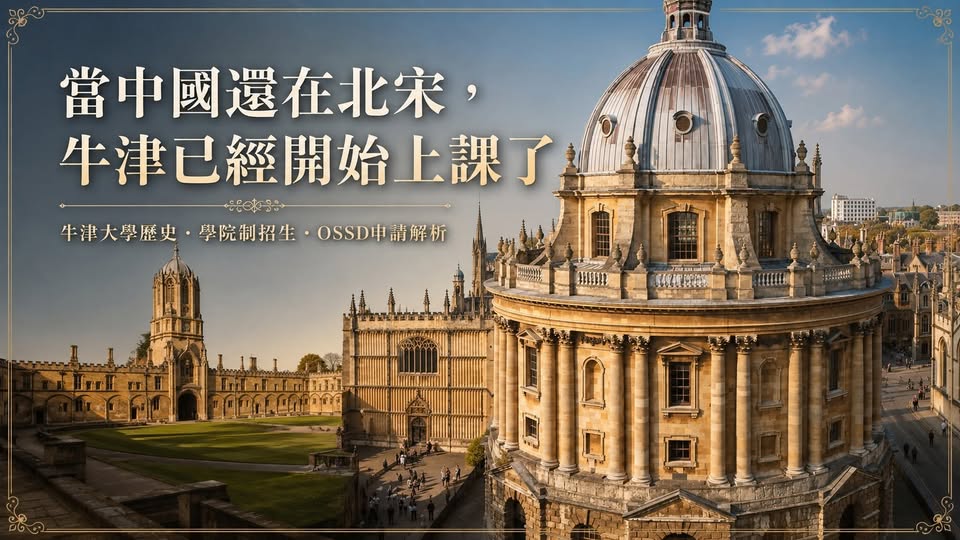
Oxford University has started its course in North Song, China, on how to apply for Oxford, and how to apply for Oxford, while China is still in North Song, Oxford University has started to have people taking classes. According to Oxford University ' s own historical records, in 1096 A.C., Oxford already had teaching activities; China's North Song period is from 960 to 1127. In other words, Oxford's academic history can indeed be traced back to North Song. It is an institution of higher education with a history of continuous schooling for more than 900 years.
By 1167, Oxford had developed rapidly after Henry II, the British King, had banned students from England from attending the University of Paris; In the 13th century, early colleges, such as University College, Balliol College and Merton College, were formed, and today our familiar "Oxford School System" is also taking shape. From North Song, South Song, Won, Ming and Ching to today's twenty-first century, Oxford still exists. Oxford is not a "school" but a large college community. The Oxford system is different from that of a general university.
Oxford undergraduates have three identities: University of Oxford students + students from one of the faculties + students from one of the Colleges. Oxford currently has more than 30 Colleges and Halls for undergraduate students. At the time of application, students may designate a College of their own liking, such as Christ Church, Magdalen, Balliol, Merton and others, or may not do so at all. That's the very special place in Oxford.
You're not applying for College, which is independent of Oxford, but you're applying for College admission at the same time as one of Oxford's undergraduates. So is Oxford a college student, or is it a college student? Oxford's undergraduate enrolment does involve a strong College, with each College having its Tutors participating in student selections and interviews. But all College must follow the common Framework for Administrations, developed jointly by Oxford.
Oxford has made it clear that the same application process is used in College and that student redistribution takes place between College. The Oxford official even pointed out that about a third of the students who were finally admitted to the school received College from Offer was not the College that they had originally appointed in UCAS. 4. Is Oxford the favorite of A Level? This is also one of the most common misunderstandings among parents in Taiwan. A Level is the leading senior university academic qualification in the British mainland, so Oxford naturally uses A Level as the reference language for most of the course pages. However, Oxford officially accepts a large number of international degrees and converts the educational systems of different countries into the A Level standard.
5. Can OSSD apply directly to Oxford? Yes. And it's not a special case. It's not about reading Foundation before applying. The official Oxford currently formally lists Ontario Security School Diploma (OSSD) as an acceptable high school qualification in Canada and directly announces how OSSD corresponds to A Love requirements. According to Ontario, currently published by Oxford, Oxford is asking for OSSD.
-
- 90 per cent of AAA Grade 12,6 4U/4M average 91 per cent of AA Grade 12,6 4U/4M average 92 per cent of the AA Grade 12,6 4U/4M average, and the six Grade 12 courses must contain the designated subjects required by the application department. There is also a very important detail.
If one of Oxford's faculties requires that a given subject must be: A ⁇ OSSD requires at least 93% of A ⁇ OSSD's designated subject to be at least 90% of the designated subject, if the applied Oxford Department requires Mathematics, Ontario students must read: MCV4U – Calculus and Victors. At present, Oxford officially provides an overview of admissions conferences: academic achievement, prognosis, Academic Reference, Personal Statement, and the possible requirements of the different scientific systems Admissions Test, Writer Work and Interview.
What Oxford really wants to judge is: does this student have the ability to study in Oxford's academic environment? Oxford's own description of the enrolment target is the search for students with academic orientation, curiosity and mobility who can adapt to the Tutoric-based learning environment. That's where Oxford has real difficulty getting in. 6. What kind of students does Oxford want? Oxford attaches great importance to one thing: the academic potential of Academic Potential. What do you think when I give you a question you've never seen before?
And that's why Oxford Interview is very special. The interview wasn't just a question: "Why do you want to come to Oxford? "What's your advantage?" "What societies have you been in?" The government of Oxford describes Interview as an academic review related to the application subject, a bit like a downsized version of Oxford Tutoria. Teachers will observe how students face new information, how they analyse it, and how they build their own reasoning. So a student's greatest competitiveness is not necessarily the best answer. It's possible that, in case of problems that don't happen, you can still think one step at a time.
Does Oxford have to have a very good background to get in? It depends on what kind of background you say. If you're saying that you have to go to an international school, you've got to be very good at home, you've got to be famous, you've got to have a professor's recommendation, you've got to go abroad, you've got to train at a world-renowned firm, you've got to be in 20 societies, you've got to have a full page of résumé, and the answer is no. The official text of Oxford is very clear about this: Tutors are concerned with students’ academicy and potential, and there is no Checklist who "must do something."
Oxford even says, in particular, that work experience and overseas travel are not necessary for any of Oxford Course. The admission teacher will not be attracted to you because you have a lot of connections, or because you have a lot of national stamps on your passport. This is very different from what many people think of as "nominal school applications". Oxford is more interested in Super-curricular than in a pile of events when a student says, "I'm at the student council. "I can play the piano. "I'm on the basketball team. "I'm going to volunteer in Africa. These experiences are, of course, good. But if you apply for Oxford History, the recruiter is more likely to want to know: What did you do to History?
For example, which history book did you read? What's the question after reading it? Did you compare the two historians' different interpretations of the same thing? Did your original point of view change by reading? If you apply for Economics: Have you really read about economics? Can the classroom theory be used to analyse real economic problems? If you apply for Physics: Are you willing to explore physical issues outside the school curriculum? These belong to the British University's application: Super-curricular Activities.
That is to say, Oxford is now even creating his own Supercurricular Hub, which encourages students to explore further the subjects they want to study through articles, lectures, Podcasts, films and a variety of issues. How much academic content do you want? Oxford has even made a very interesting suggestion at the moment: Personal State: about 80 percent of Academic Enterprises, Abilities and Achievements, and the rest: 20 percent of extracurricular activities that are not directly related to applications.
Moreover, starting with the current UCAS system, the Personal Statement has been changed from a large past article to a three-problem structure, with the total word limit remaining at 4,000 characters. Start accumulating Super-curricular. Reading, research, academic competitions, topics, public lectures, Online Course, Essay, Podcast and even autonomous research can be academic exploration. The focus is not on how gorgeous the name of the event is. And you're thinking about something from inside. From North Song to today, Oxford has always chosen scholars to look back over 900 years and find an interesting thing. In 1096, China was still in North Song.
However, Oxford has begun to gather in the city to learn and lecture. After more than 900 years, the system has changed, the application has changed, with students coming from all over the world. But the spirit at the heart of Oxford's admission is still very "Oxford": how curious are you about a subject? Would you like to go deeper? Can you think when the teacher asks a question that has no standard answer? Therefore, access to Oxford does not require a prominent family background and does not require A Level. Academic achievements, subject preparation, academic exploration, ability to think, and the potential you have shown for the subjects you have applied for. That's the most important thing to understand when Oxford recruits.
