"Readering the System, Choosing the World"
Australian tax change 2026-27: Student families need to rethink Australia's course.
Australia 2026-27 tax changes, ostensibly investment houses, CGT, trust and income tax issues. In the international education context, however, parents are reminded that studying in Australia is entering the era of “degrees + employment + tax + assets”.
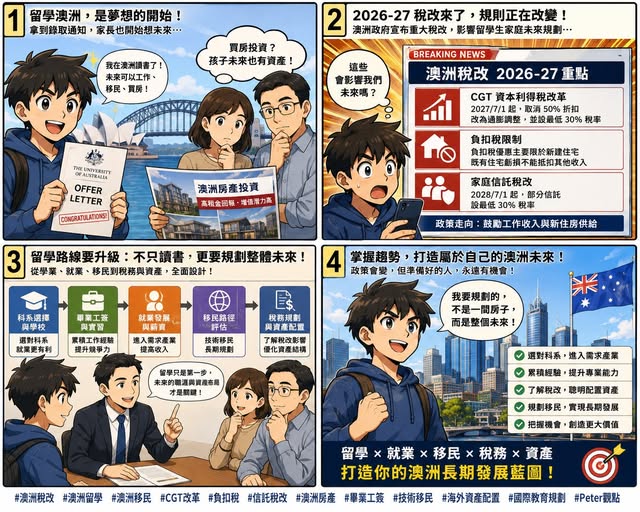
Australia 2026-27 tax changes, ostensibly investment houses, CGT, trust and income tax issues. In the international education context, however, parents are reminded that studying in Australia is entering the era of “degrees + employment + tax + assets”. Why does this have to do with studying? In the past, Australian properties were often seen as part of the allocation of household assets, and investment houses, tax deductions, discounts on capital gains were seen by many families as a reasonable route for “children to develop in Australia and accumulate property in the meantime”.
But with this change, the Australian government has released the signal that the future resource will be more favourable, with 50% discounts replaced by an inflation adjustment model and a minimum 30% tax on capital imports from 1 July 2027. Tax deductions will also be directed mainly towards the construction of new dwellings. After-school development, will this department be able to enter the relevant areas of the Australian Skills List after graduation? Is the post-graduation salary sufficient to support renting, living, loans and taxes? What is the difference between the tax on new dwellings and established ones if they are to be bought in the future? What are the new costs that households incur if they use trusts or overseas asset arrangements?
With effect from 1 July 2028, Australia will also introduce a 30% minimum tax on some of its tax liabilities, which will have an impact on household wealth inheritance and asset allocation. For students preparing to study in Australia, the focus is on what to do after graduation. Australia's study abroad is still of high value, especially in the fields of nursing, education, engineering, information technology, social workers, construction, health-related and technical occupations, and remains highly attractive. But when choosing schools and subjects, parents need to stretch the problem:1 Is there a need for employment in this department? Are there opportunities to obtain relevant work experience after graduation? Is the cost of living in the city reasonable? 4 Is there a migration connection in the future?
Should family asset arrangements be redesigned if the child remains in Australia for a long period of time? High-paying departments and ability to work are more crucial than simply buying a home. What is more important in the future is whether a child can enter the talent areas needed in Australia: internships, permits, pre-enrolment of professional registration; Post-graduation income against Australia's high cost of living; whether household assets are adjusted in step with the local tax system; whether the Australian government limits the existing residential deductions and reserves incentives for new housing, representing a gradual shift from "investment demand" to "housing supply". Officially, it is also indicated that existing investment arrangements can be followed by those who acquire them by a specified time.
Singapore: Asia International Education Hub
The system is the map, the choice is the direction.
