"Readering the System, Choosing the World"
Canadian student visa application package.
And here's the document, which determines whether students can legally study in Canada. The logic of applying to universities, research institutes and secondary schools varies, particularly since 2026, Canada has more closely reviewed international student quotas, PAL/TAL, financial certificates and secondary school custody documents.
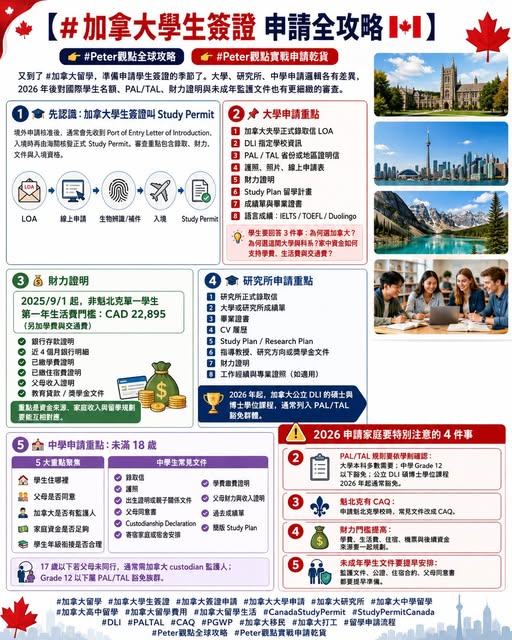
Again, this document determines whether students can legally study in Canada. The logic of applying to universities, research institutes and secondary schools varies, particularly since 2026, Canada has more closely reviewed international student quotas, PAL/TAL, financial certificates and secondary school custody documents. First recognize: Canadian student visas are called Study Permit, which is usually received after approval of a student's application from abroad, before being formally issued by Customs at the time of entry.
IRCC Officially states that the application of Study Permit is checked for admission, financial resources, documentation and eligibility to enter the country according to the student ' s background.
Focus on university applications: DLI, PAL/TAL, Financial Certificate, Studi Plan Application for undergraduate studies at the University of Canada. The core document usually includes:1 Official Admission Letters to the University of Canada, LOA 2 DLI Designated Schools Information 3 PAL / TAL Provincial or Territory Certificates,4 Passports, Photos, Online Application Form 5 Financial Certificates 6 Study Plan Study Certificates and Certificates7 Language Performances, such as IELTS, TOEFL, Duolingo Canada currently requires most applicants for higher education to submit PAL or TAL, representing approved student places in the province or territory.
IRCC also lists the PAL/TAL file page, which is accessible to students according to the provincial and school instructions. Students want immigration officers to understand three things: why Canada chooses this university and faculty; how home funding supports school fees, living expenses and transportation costs; and financial evidence: one of the most important core of the review of Canadian visas is the key word that parents search most often for. IRCC requires students to prove that they have sufficient funds to pay for school fees, maintenance and return transportation. With effect from 1 September 2025, the first-year cost-of-living threshold for single students in non-Quebec is CAD 22,895, which is added to the cost of tuition and transportation.
Common financial documents include: bank certificates of bank deposits for nearly four months, bank details of fees paid, proof of payment of accommodation fees, proof of parents' income, certificate of education loans, certificate of scholarship, financial documents that focus not on a single amount of money in an account, but rather on matching funding sources, family income and student study plans. The Institute's application focus: the master's degree rule of 2026 is more favourable to apply to the Canadian Institute, and documents place more emphasis on academic coherence than universities.
M.A. and Ph.D. students prepare: 1 Institute ' s Official Admission Letter 2 University or Institute Certificate 3 C.V. 4 C.C.C.E.L. 5 Studiy Plan or Research Plan 6 documents for guidance professors, research orientation or scholarships 7 Financial Certificate 8 Work experience and professional certification, if relevant to the Faculty of Sciences, from 2026 onwards, students of the public DLI Master ' s and Ph.D. degree courses in Canada are usually included in the PAL/TAL exemption group. The IRCC Proclamation also lists public Dr. DLI Suk students as subject to PAL/TAL exemptions in 2026. Focus on secondary school applications: Under 18 years of age, Canadian secondary school applications differ significantly from university institutes.
For example, the focus of the visa review is not only on admission to school, but also on whether parents consent to the existence of a guardian in Canada The adequacy of family funds The reasonableness of the student grade transition IRCC states that under 17 minor students who have not been accompanied by their parents or legal guardians are required to be a Custodian guardian by Canadian citizens or permanent residents; Students over 17 years of age may request it on a case-by-case basis.
Common documents for secondary school students include: 1 Secondary School or Education Board Admission Letter 2 Passport 3 Birth Certificate or Parent-Child Relationship Document 5 Parental Consent 5 Custodianship Regulation 6 Certificate of fee fees for residential families or dormitories 7 Certificate of parental financial resources and income 9 Certificate of past report card Story Plan, and the following 12 Grade students belong to the PAL/TAL exempted community. The IRCC 2026 Proclamation states that kindergarten to Glade 12 students are exempt from PAL/TAL.
The PAL/TAL rules are to confirm most of the undergraduate needs of the university. Secondary school Grade 12 Exemptions below. The public DLI Ph.D. degree programme is usually exempted since 2026. 3 When there is a CAQ application in Quebec for a school in Quebec, the usual document is changed to CAQ and the application is prepared in accordance with the instructions of the school and province. Parents plan for school fees, living expenses, accommodation, airline tickets together with subsequent funding sources. A custody document, notarization, accommodation contract, and parental consent will require time for processing.
Australasia: new options for schooling, application and study abroad
The system is the map, the choice is the direction.
