"Readering the System, Choosing the World"
2027, is it a good time for Canadians to study and immigrate?
) Canadian official announcement: 2026-2028 Immmigration Internationals Plan has included international students in temporary residential management.
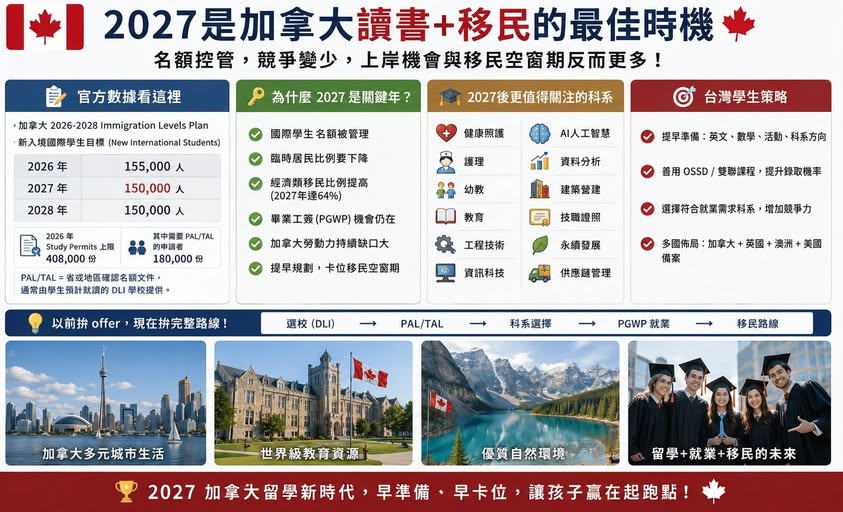
) Canadian official announcement: 2026-2028 Immmigration Internationals Plan has included international students in temporary residential management. The official page listed 155,000 new international students in 2026 and 150,000 in 2027 and 2028. IRCC further indicated that a maximum of 408,000 cases were issued in 2026, of which 180,000 were allocated to applicants in need of PAL/TAL; PAL/TAL is a provincial or territorial quota document, usually provided by the DLI school where the student is expected to attend.
Many parents have recently seen fewer international student places in Canada, and the first response is: "Is Canada getting harder and harder?" My opinion is quite the opposite. Behind the numbers is the opportunity to redo cards, and many people have seen the places fall, and they're thinking about "higher threshold," which means that the market is sorting out. In the past, the Canadian market for study abroad was too hot, with large numbers of applicants, large enrolments in schools and a lack of competition. Now that Canada has begun to screen students, it has given more opportunities to prepare families to land.
Canada also has three signals: one international student quota is being managed and the percentage of temporary residents is declining; three economic categories of immigrants are increasing; in other words, the students that Canada wants are becoming more and more obvious: academically prepared, English-speaking, graduate-level employment, and the Canadian workforce gap, and the opportunity to connect to migration routes in the future, which is good news for Taiwan students. Because Taiwan’s students are generally capable of learning, families value education, if... which faculties are more deserving of attention after 2027? If the target is read + employment + immigration in Canada, I would suggest that parents pay particular attention to these directions: these areas are highly relevant to the ageing of the Canadian population, infrastructure, technological transformation, educational needs, and the health workforce gap.
When choosing the faculty, don't just look at the names. It depends on the ability of the child, the talent needs of Canada, the diploma sign, the job market and immigration routes. Why, for Taiwan students, the greatest value of the OSSD or the Taiwan-plus twin route is to prepare Canadian high school academic skills ahead of schedule. Students can complete the following in Taiwan: Glade 12 English, Grade 12 Math, G12 specialized subjects for the admissions department English Writing training course Professor Peters Reference Letters International Exchange of Experiences University applications material, when the Canadian quota enters control, it is better to prepare a full student. For what Canada wants in the future will be people who can read, graduate, work and stay.
Peter's sentence to parents 2027 Canadian policy changes, ostensibly a decline in quotas. But this may be a good window period for prepared families. Fewer competitors, tougher systems and matured markets. The sooner the English language, achievement, department, activity history and course of advancement are prepared, the better the opportunity to get stuck in the new system. So, 2027 isn't Canada's exit. 2027 is the time for Canada to enter the screening era. Whoever understands the rules first has a better chance of landing.
