"Readering the System, Choosing the World"
It's probably underestimating Toronto Metropolis by looking at world rankings.
University introduction: When it comes to universities in Toronto, Canada, many parents start thinking about University of Toronto. But if the student cares about another thing: "Can I get into Canada more quickly after college?"
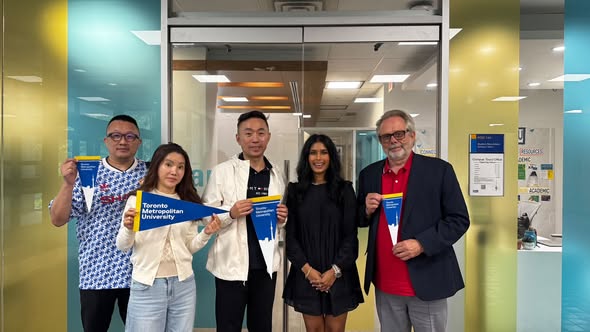
University introduction: When it comes to the University of Toronto in Canada, many parents start thinking about the University of Toronto. But if the student cares about another thing: "Can I get into Canada more quickly after college?" Ryerson University, in downtown Toronto, is a very well-known university. It has been characterized not as an ivory tower that separates itself from the city, but as a direct place of business, industry, internships, entrepreneurship and the city itself in university education. And in recent years, TTU has been undergoing a rapid transformation.
From business colleges, engineering, dissemination, design, to law, AI, entrepreneurship, to the school of medicine, which will be officially opened in 2025, the TTU ' s development path is quite noteworthy. One of the greatest advantages of TTU: you're not living near Toronto, you're at 350 Victoria Street, downtown Toronto, near Downtown Toronto, Yonge Street, Dundas Square, Toronto Eaton Centre. In other words, where students live on a daily basis, they are themselves one of the largest commercial and employment markets in Canada.
Banks, technology companies, the media, retail sales, government agencies, start-ups, medical institutions and the design and entertainment industry are all concentrated in the city. That's why I've always thought that looking at the University of Canada is not just a ranking figure. For an 18- to 19-year-old university student, “where is the university” sometimes has a direct impact on the number of businesses, internships, activities, connections and job opportunities available in four years. TTU is the classic "TTU is not actually a new university that suddenly emerged and the history of TTU dates back to 1948."
After the end of World War II, Canada required a large number of skilled personnel, which led to the establishment of Ryerson Institute of Technology, which initially had about 225 students, with a strong focus on professional and industrial needs, including construction, photography, clothing design, etc. It's important. Because it also explains why today the TRU has a special emphasis on: Career-focused education, Experiential Learning, Co-op, Innovation. Awarded a degree in 1971, formally acquired university status in 1993 and became Ryerson University in 2002.
By 2022, the official name was changed to Toronto Metropolitan University. Today, TTU has developed into a large, integrated university with more than 100 university and research programmes, about 48,000 students and more than 245,000 alumni worldwide. So if you want to understand TTU, rather than think of it as a "newer Canadian university", it should be understood as a school that has been upgraded from applied technology education to a major city complex.
What is really interesting about TTU is that it has a lot of Co-op from the University of Canada, but the data released by TTU in 2026 show that 96.6% of the courses include some form of external learning, including Co-op, Internship, Clinical Space, etc. The official Co-op work term is usually a full-time paid job of 35 to 40 hours a week for 16 weeks; Depending on the faculties, students may need to complete three to four work terms, and some courses may be arranged for longer periods of continuous work.
Moreover, the TTU stipulates that the position as official Co-op credit must, in principle, be Paid Work. The company listed as a partner or a company that has hired students can see the following: Bombardier Aerospace, Air Canada, Hydro One, IBM Canada, Scottiabank, Toronto Hydro, TTC, PCL, Apotex, etc. Of course, it's a special reminder: Co-op is not a school guarantee to send you a job. Students still need to prepare their curricula vitae, interviews, job vacancies and competition with other students. This is closer to the real job-seeking environment in Canada. So, what's the employment status of the fucking graduates?
Here is a set of official figures that deserve the attention of parents. TTU published in the April 2026 update of Ontario Ministry Key Performance Indicators: 2022 bachelors and first-degree graduates: employment rate six months after graduation: 85.1%; employment rate two years after graduation: 90.5% why apply for TMU with OSSD is particularly advantageous? This is very important for Taiwan students. Because TTU itself is a university in Ontario, OSSD itself is Ontario Security School Diploma.
In other words, the upper secondary school curriculum for students is directly related to the admission system used in universities. TTU currently has basic requirements for Ontario Security School Centres, namely: OSSD + 6 Glade 12 U/M courses + designation of a first course. The basic average of the six 12th grade U/M courses is 70 per cent, but the actual admission threshold in the hot schools is usually raised by competition. And all faculties need Glade 12 U Engineering; There are also prescribed courses in mathematics, Calculus, Science and others. And that's one of OSSD's biggest applications advantages: what universities want, what they can plan for in high school.
If you want to apply for business, you can arrange the required math and 12U/M courses. In order to apply for work, the necessary subjects such as the Advanced Operations, Calculus, Physics and Chemistry are included in the high school study programme. Applications for dissemination, design, Creative School, in addition to achievements, are made for the preparation of required works or non-academic material in advance. Moreover, the official TTU has made it clear that the Grade 11 results may be used for the Earth Mission review, which will then be completed with the Grade 12 finals. And that's why OSSD's promotion plans can't wait for seniors to start.
In addition, OSSD does not necessarily exempt IELTS or other proof of English proficiency. TTU currently provides that an exemption from the English test may only be granted if the pupil has completed the qualifying four-year full-time Canadian, English-speaking national or school education in which English is the main language of instruction; The school retains the right to require proof of English proficiency. And the next thing I think that's going to be of the greatest interest is that in 2025, TTU officially did a very big thing: School of Medicine officially opened in Brampton. This is the first new medical college in more than 100 years in most of the Londo region.
In the first year there were 94 MD students, with over 6,400 applications; The training of post-graduate physicians was also initiated, and TTU was the first Canadian new school of medicine to be launched simultaneously with postgraduate medical education. This development means a lot to the TTU. Because in the past, people thought about TRU, they thought about business, the media, design, engineering, technology and entrepreneurship. The school map now extends to: Law + Medicine + Health Sciences + AAI + Urban Studies + Sustainable Development + Innovative Entrepreneurship.
However, TTU published 2025-2030 Academic Plan and Strategic Research Plan, which also include "Future Studies", research innovation, industrial cooperation, health and social issues, among others, at the heart of future development. More notably, the international ranking of TTU has continued to rise in recent years. In 2026, it was pointed out that TRU had become one of Canada ' s largest rises in the ranking of QS World University in almost two years and had reached the top 10 per cent of the world ranking of QS University; The reputation of employers, research references and sustainability are important factors in promoting ranking. Cities, industry, universities, Co-op and the upper secondary school system are placed on the same path.
It's probably the best place for TTU to study.
