"Readering the System, Choosing the World"
U.S. University is recovering SAT review.
After the epidemic, many universities in the United States once adopted the test-optional, i.e. students could choose not to submit their SAT/ACT scores.
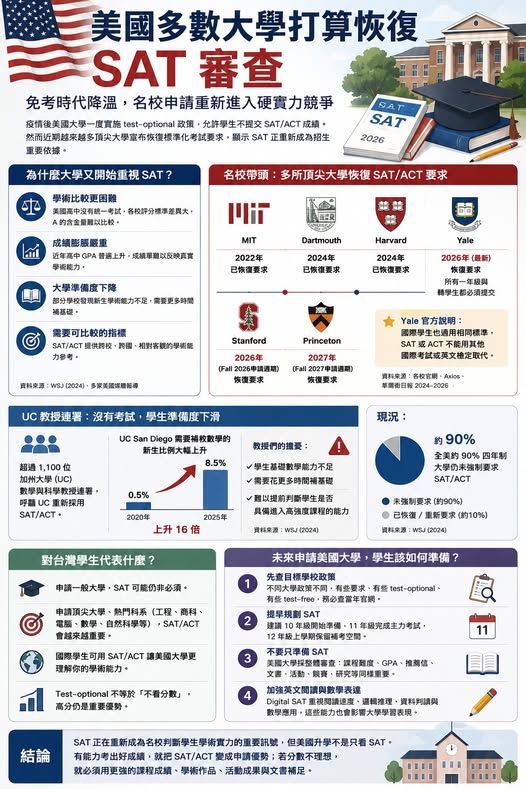
After the epidemic, many universities in the United States once adopted the test-optional, i.e. students could choose not to submit their SAT/ACT scores. The reasons for this were simple: the epidemic affected the opening of the examination and the unequal access of students to the examination; At the same time, the United States community has long questioned the advantages of standardized examinations for high-income families. But in recent years, the wind has begun to change. A growing number of top universities have resumed SAT/ACT requirements, including MIT, Dartmouth, Harvard, Yale and Stanford.
This means that the U.S. university application did not fully return to the era of “test-only”, but the idea of “no-test at all” has clearly cooled down. Why is SAT invited back to the admission table? The most important reason is that the university found that it was more difficult to judge enrolment without standardized results. There is no single national examination for U.S. high schools and there are significant differences in the rating criteria for schools. Similarly, A, different upper secondary schools may represent entirely different academic difficulties. This is particularly true for private high schools with branches in China. In addition to the high levels of performance in recent years, many students have excellent GPAs, well-written references, and their résumés are packaged. At this point, the SAT/ACT became a relatively comparable academic reference.
MIT has already resumed SAT/ACT requirements. Dartmouth and Harvard are also following up. Yale also announced that applications for SATs or ACTs were required for both grade 1 and transition students, as were international students, and that English testing was not a substitute for standardized examinations. Stanford will also restore SAT or ACT requirements from the Fall 2026 application cycle. The policies of these schools are indicative. Even though there are still universities in the United States that maintain the test-optional, the shift to top-level universities will affect the preparedness strategies of students and parents.
UC is still a test-free system that does not use SAT/ACT as a basis for enrolment. But there are more than 1,100 UCs recently reintroducing SAT/ACT. The reason for this is that some of the new students are entering university, and the mathematics and STEM base is inadequate, and the professor needs to spend more time on basic skills. This controversy shows one thing: the discussion of SAT is not just about fairness, it's also about... this trend is very important for students in Taiwan. Over the last few years, many families have heard that "U.S. universities can not send SATs" and thought that they could apply for SATs completely unprepared.
For international students, SAT has a special function: it helps American universities understand the academic abilities of students under different educational systems. Taiwan ' s high schools, international schools, OSSD, AP, IB, A-Level are rated differently. When universities face global applicants, SAT/ACT can be a cross-country, cross-college comparative tool. A lot of people misconstrue the test-optional. It means that the school allows you not to submit SAT/ACT. But that does not mean that high marks are not helpful. If your SAT/ACT scores are higher than the average student intake in the school, submitting scores will generally still enhance the application.
The first step in applying for U.S. universities in the future is to confirm the target school policy. Different universities may be required, test-optional or test-free, not just Internet or bad-quality intermediaries. If the target is a school name, early planning of SAT is recommended. It would be preferable to begin familiarization in the tenth grade, complete the primary examination in the eleventh grade and retain additional space during the twelfth grade. But remember, SATs aren't all. United States universities still have a holistic review, and the difficulty of courses, achievements, English writing, research programmes, competitions, community service and personal characteristics remain important. Applications for universities in the United States in the coming years will place increasing emphasis on integrated strength.
SAT is not all, but it is re-establishing itself as an important signal of the academic ability of students.
