"Readering the System, Choosing the World"
Report on the crisis of trust at Yale University
More recently, Yale University published a report of the Committee on Trust in High Education, which is worth reading by all educators, parents and students.
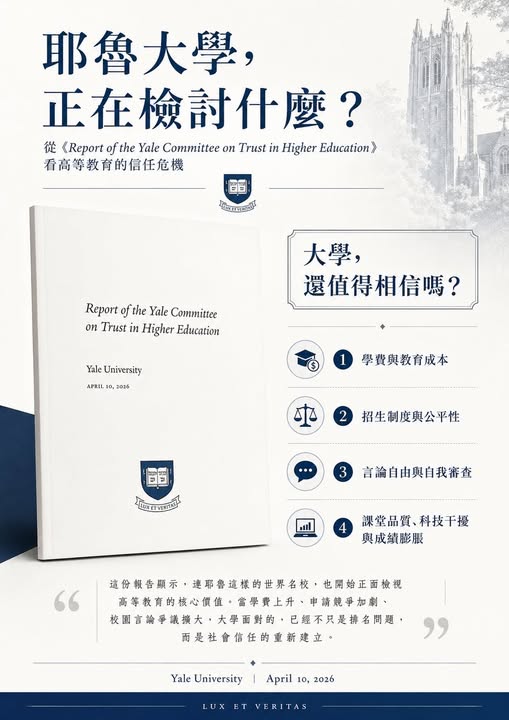
More recently, Yale University published a report of the Committee on Trust in High Education, which is worth reading by all educators, parents and students. This report was commissioned by the Principal of Yale, Maurie McInnis, in April 2025, and officially presented in April 2026, with a focus on the "Crisis of trust in higher education". At the beginning of the report, it was noted that 57 per cent of Americans had a high level of trust in higher education, which fell to 36 per cent by 2024.
The key to the discussion of this report is not the single event in Yale, but the beginning of a positive review of world-class schools like Yale: What is the value of universities? After high school fees, do students and families get knowledge, abilities, ideas and life choices, or do they have a school calendar and curriculum vitae symbol? The first problem that Yale identified was the subsequent announcement that, from the 2026-2027 school year onwards, families with an annual income of less than $200,000 would receive scholarships covering at least school fees; Households with an annual income of less than $100,000 can cover the full cost of schooling.
The second question, which was created in 2025, was the achievement, while emphasizing that the third was that, in the annual school survey, nearly a third of university students expressed doubts about the phrase "I can freely express political views on campus," which is more than 17 per cent higher than in 2015. This represents a challenge for top universities, which has been extended from "who can go to famous schools" to "do students dare to think, ask questions and debate when they enter famous schools." More notably, Yale put the classroom itself back in the centre. The report recommended GPA standards or the inclusion of class percentages on the report card. For parents and students in Taiwan, the Yale report provides an important reminder that the choice of university is no longer limited to ranking, name and admission.
The real question is, how does this university teach students how to think? How do you evaluate students ' abilities? How can we face different views? How can students translate knowledge into future professions, responsibilities and choices? The most positive thing about this review by Yale is that it did not push the crisis to the outside world, but rather recognized that higher education itself has blind spots. It is also an important signal for international education: future students need not only the ability to enter a school of fame, but also the ability to judge whether a university is worth investing in four years of youth and family resources. Into college,
