
"Readering the System, Choosing the World"
Recent analysis of the authority to study abroad: seeing 2027 trends in study abroad
The latest analysis of the authority to study abroad: seeing the trend of 2027.
The latest analysis of the authority to study abroad: seeing the trend of 2027.
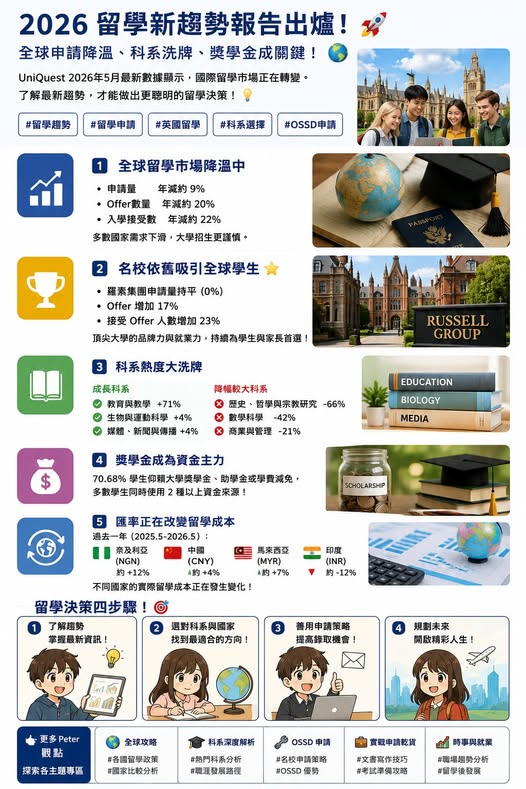
According to the May 2026 international enrolment data of the British International Admission Statistics Authority, UniQuest, in May 2026, the overall number of international applications for admission in September 2026 fell by about 9 per cent compared to the previous year, the number of Offers fell by about 20 per cent, and the number of people who accepted Offers fell by about 22 per cent. At a time when the heat in the market is cooling, students are more careful in their calculations of investment in education. In the face of the risk of visa compliance and licensing, the University of England has been more cautious in issuing visas, and some of its partners have temporarily scaled down the Pakistani and Bangladeshi markets.
At the other end of the spectrum, Russell University Group showed a bright movement: the number of applications was 17 percent the same as last year's, the number of people who accepted Offer grew 23 percent, a set of figures that revealed a signal that when the market was shrinking, brand reputation, the results of employment and better academic resources in universities tended to concentrate more high-quality applicants. The British market for study abroad is moving towards a pattern of "stronger" division. In 2026, the Offer holder's data showed that teaching-related departments grew by 71 per cent, much more than in other areas. Two percent growth, four percent growth, and the media four percent growth.
On the other hand, some of the traditional faculties are facing a marked decline: history, philosophy and religious research: a 66 per cent decline; mathematics science: a 42 per cent decline; synthesis and general research: a 30 per cent decline; design, creative and performing arts: a 22 per cent decline; business and management: a 21 per cent decline; construction and urban planning: a 21 per cent decline; and even an 8 per cent decline. There is still a market demand in hot schools, and competition for admissions and student choices are more focused on employment outcomes; internships are linked to professions. According to the information, 70.68 per cent of students included university scholarship grants or tuition fee deductions as their main source of funding; 54.06 per cent plan to work during the school year; 41.50 per cent dependent on government subsidies; 35.99 per cent use family support or personal savings.
This represents a central condition for recruitment competition. For Taiwan's students and parents, in addition to the amount of tuition fees, a comparison is made between the amount of scholarships and the conditions of maintenance 2 for accommodation and living expenses 3 for internships or paid internships 5 for post-graduation career service 5 Changes in the overall budget and exchange rate for study abroad 5 Among the student selection factors, the highest scores are 87 points for tuition and financial support, followed by 84 points for graduates' employment results, 83 points for internships, 82 points for accommodation and 81 points for teacher background and quality of teaching. The university ranks are 73 and the school history and tradition 69 points. It's an interesting sort of thing. Students continue to value brand names, and the focus of decision-making is gradually shifting to 2027 applications for study.
For the students preparing their applications, three tests can be completed: does the graduate of this department go for your career? Does the school offer internships, business cooperation and career guidance? Is the scholarship and total budget in line with family arrangements? The application is still worth trying, but the name needs to be assessed with the department's quality, career results, cost structure. The core of the selection has gradually shifted from "which university is better ranked" to " which one offers better long-term value." International enrolment in 2026 reminds students and parents that British study abroad is still globally attractive and that the market is entering a more precise selection phase.
The continuing growth of the Russell University Group attests to the strong demand for top education brands; The top ranking of employment outcomes and internship resources also represents a greater emphasis on the link between education and career for new generations of students. Please put the university ranking in the comparative table, and also put the tuition scholarship, the internship, the graduation route with the exchange rate. This option relates to a diploma and to career orientation and family resource allocation in the following years. Click on the bottom label to see more of Peter's depth analysis: Source: UniQuest International Monthly Data Comparison, May 2026
